In modern enterprises, video conferencing has become a core communication infrastructure rather than a supplementary tool. Organizations rely on it for daily operations, strategic discussions, and cross-regional collaboration. At the same time, enterprises face growing pressure to protect sensitive information, maintain compliance, and retain full control over their communications. This is why secure video conferencing is no longer defined only by user-facing features, but by what happens at a deeper technical level—the communication protocols.
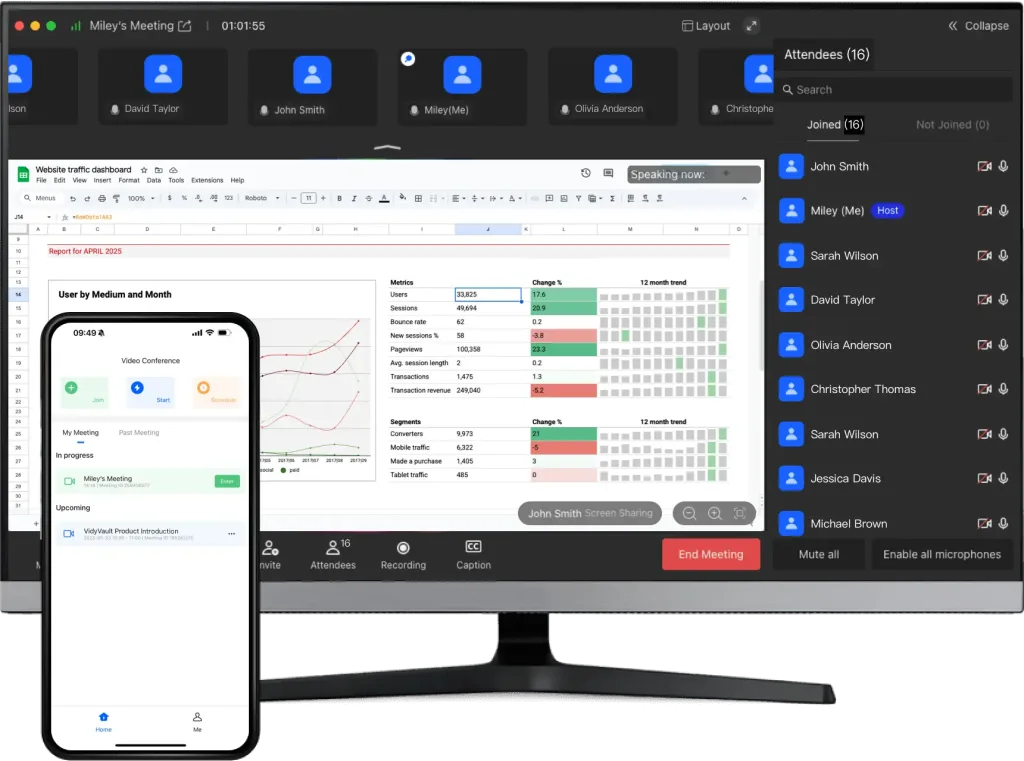
Protocols determine how data is transmitted, encrypted, authenticated, and protected. They directly affect privacy, reliability, scalability, and operational efficiency. VidyVault’s on-premises video conferencing architecture, combined with carefully optimized security protocols, is designed to deliver high-quality communication while ensuring that enterprises retain full ownership and control of their meeting data. This protocol-driven approach enables organizations to scale confidently without sacrificing security or performance.
Why Protocol Choice Defines Secure Video Conferencing
The choice of protocols is foundational to any secure video conferencing platform. It shapes not only how data flows through the system, but also how effectively the platform defends against threats and supports large-scale enterprise use.
At the most basic level, protocols define how information is transmitted between participants. Weak or outdated protocols can expose data to interception, tampering, or unauthorized access. For industries such as finance, legal, healthcare, and government, where confidentiality is non-negotiable, protocols must support end-to-end secure communication while keeping all data within the organization’s controlled infrastructure.
VidyVault prioritizes protocol choices that align with enterprise security expectations, ensuring that communication channels remain protected throughout the entire meeting lifecycle—from signaling to media transmission.
Performance and Scalability as Protocol Outcomes
Beyond security, protocols also influence performance. Latency, stability, and interoperability are all protocol-dependent. Enterprise video conferencing often involves hundreds or even thousands of participants, diverse network environments, and high expectations for audio and video quality.
Well-designed protocols enable low-latency communication, stable screen sharing, and consistent performance even under heavy load. This is essential for organizations that rely on video conferencing for large meetings, training sessions, or cross-department collaboration.
TLS 1.3 for Secure Signaling
In VidyVault, all signaling data is protected using TLS 1.3 encryption. Signaling includes critical information such as session setup, participant authentication, and meeting coordination. By securing this layer with TLS 1.3, VidyVault blocks interception and tampering attempts during data transmission.
This protocol choice establishes a strong security baseline for day-to-day enterprise communication. It ensures that meeting initiation, control messages, and coordination data remain confidential and trustworthy, forming the groundwork for a reliable and encrypted video conferencing experience.
DTLS-SRTP for Media Encryption
While signaling sets up the meeting, the core of video conferencing lies in the media streams themselves. VidyVault secures audio and video streams using DTLS-SRTP encryption, a widely trusted approach for real-time communications.
DTLS-SRTP protects the actual content of conversations—voice, video, and shared media—ensuring that even if network traffic is intercepted, the data remains unreadable. This robust encryption layer is particularly important for privacy-critical industries such as law firms, healthcare providers, and regulated enterprises, making VidyVault a dependable secure video conferencing platform in high-stakes environments.
Supporting Seamless, Secure Enterprise Collaboration
Strong protocols should not create barriers for users. VidyVault’s protocol approach is designed to support seamless collaboration while maintaining strict security standards.
Today’s enterprises operate across multiple locations and device types. Employees may join meetings from desktops, laptops, or mobile devices, depending on their role and environment. VidyVault’s protocol framework supports multi-endpoint access, allowing participants to join securely from any approved device.
This flexibility enables distributed teams to collaborate effectively without compromising security. Protocol-level protections ensure that each connection meets enterprise standards, regardless of where or how participants join.
VidyVault integrates essential collaboration features directly into the platform, including standardized screen sharing and AI-assisted meeting minutes. Because these features are built on the same secure protocol foundation, organizations do not need custom development or third-party plugins to enable effective collaboration.
This approach allows teams to focus on productivity rather than technical setup, while IT departments maintain confidence that all collaborative functions operate within a secure, controlled environment.
Easy Deployment and IT-Friendly Management
Security protocols are most effective when they are paired with deployment and management models that support enterprise IT operations. VidyVault is designed to be both secure and practical for internal teams.
VidyVault supports quick installation with minimal configuration, enabling organizations to deploy on-premises video conferencing without long setup cycles. This allows enterprises to move rapidly from evaluation to production use, while still benefiting from a protocol-driven security architecture.
For organizations that must respond quickly to operational or regulatory demands, this rapid deployment capability is a significant advantage.
Full IT Control Without Third-Party Dependence
By deploying VidyVault on-premises, organizations retain full control over permissions, updates, and usage monitoring. IT teams can manage access policies, review system activity, and apply updates internally—without relying on external cloud providers or third-party operators.
This model reduces dependency risks, simplifies compliance, and gives enterprises direct oversight of their communication environment. It strikes a balance between strong security and operational efficiency, ensuring that protocols, infrastructure, and governance work together seamlessly.
Conclusion: Protocols as the Foundation of Trust and Performance
In enterprise environments, protocol choice is fundamental to secure, reliable video conferencing. It determines how well a platform protects sensitive data, supports large-scale collaboration, and integrates into existing IT ecosystems. VidyVault’s protocol-driven design—combining TLS 1.3 for signaling, DTLS-SRTP for media encryption, and a robust on-premises deployment model—ensures data privacy, organizational control, and high performance.
For organizations that prioritize confidentiality, reliability, and full ownership of their communications, VidyVault offers a secure video conferencing system built on the right technical foundations. By aligning advanced protocols with on-premises video conferencing, VidyVault enables enterprises to collaborate confidently—without compromising security, scalability, or control.